Dry Versus Wet Carpet Cleaning for Offices
A carpet can look presentable at 8am and still hold the tracked-in soil, drink spills and fine dust that shorten its useful life. For facilities teams, dry versus wet carpet cleaning is therefore not simply a choice between two cleaning techniques. It is a decision about workplace readiness, access, air quality, appearance and how reliably a building can operate around the cleaning programme.
The right method depends on the carpet construction, the level and type of soiling, occupancy patterns, ventilation and the time available before staff or visitors return. In many commercial premises, the strongest approach is not an either-or decision. It is a planned combination of routine low-moisture maintenance and periodic restorative cleaning.
Dry versus wet carpet cleaning: the practical difference
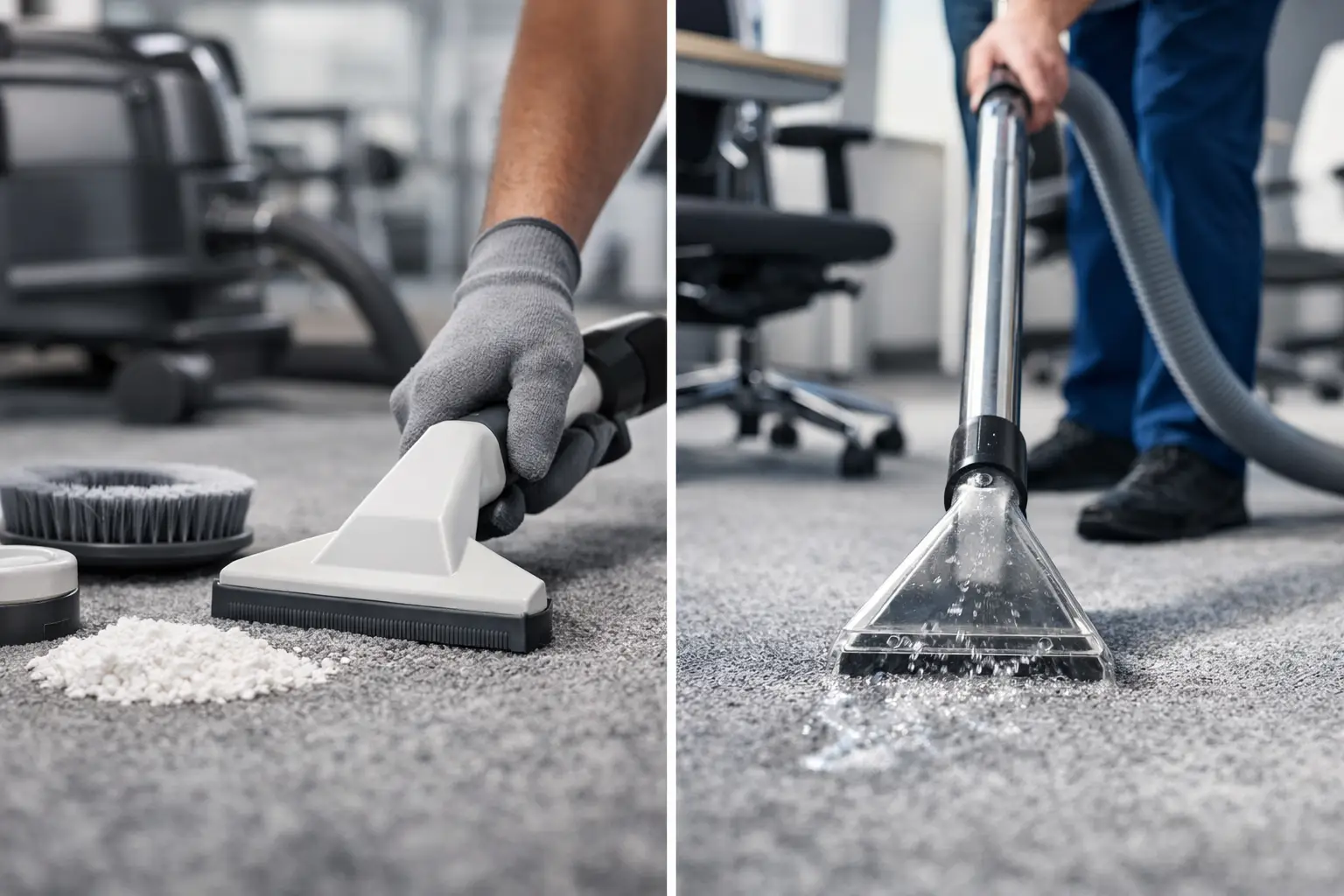
Dry carpet cleaning uses very little moisture. Depending on the system selected, a cleaning compound may be worked into the pile to absorb soil before being vacuumed away, or an encapsulation solution may be applied and agitated. The solution surrounds loose dirt as it dries, allowing it to be removed through vacuuming.
Wet carpet cleaning, often referred to as hot water extraction, applies water and an appropriate cleaning solution into the carpet before extracting the suspended soil and moisture. Professional equipment controls water delivery and recovery, but the carpet will still require drying time.
Neither description tells the full story. A well-managed wet clean should not leave carpets saturated, while some low-moisture methods use more solution than the word “dry” suggests. The operational question is how much moisture is introduced, how effectively soil is removed and when the area can return to normal use.
When dry carpet cleaning makes sense
Low-moisture cleaning is particularly useful where access and continuity are the overriding priorities. An occupied office with busy walkways, meeting rooms and shared workspaces may need carpets refreshed without lengthy closures. Because drying is usually rapid, teams can often clean an area outside peak use and return it to service promptly.
This method is well suited to routine maintenance where soil has not become deeply embedded. It can improve the appearance of traffic lanes, remove dry particulate matter and help maintain a consistent professional standard between deeper cleans. It also reduces the risk of damp carpets being walked on before they are ready, which can transfer soil from entrances and lifts straight back into the pile.
For facilities managers, this can make scheduling more straightforward. Smaller zones can be treated around meetings, shift patterns or restricted-access requirements, with less disruption to desks, furniture and day-to-day activity.
There are limits. Dry methods may be less effective where a carpet has heavy staining, sticky residues, drink spills or accumulated soil deep at the base of the fibres. If the carpet has not been maintained regularly, a surface refresh alone can leave the underlying issue unresolved.
Where low-moisture methods need care
The quality of the result relies on correct product selection, mechanical agitation and thorough vacuuming. Insufficient vacuuming can leave cleaning residues or encapsulated soil behind. Equally, applying a product without first removing loose grit can reduce effectiveness.
Carpet manufacturer guidance also matters. Fibres, dyes, backing materials and stain-protection treatments vary. A competent contractor should assess the carpet, carry out testing where appropriate and select a method that supports the floor covering rather than risking damage or colour loss.
When wet carpet cleaning is the stronger option
Wet extraction is often the preferred choice for restorative cleaning. The process can reach further into the carpet pile to lift ingrained soil, residues and contaminants that routine vacuuming or low-moisture cleaning may not fully remove. In a corporate setting, this is valuable in entrance routes, collaboration areas, breakout spaces and other high-footfall zones.
A professional wet clean can also help reset the carpet as part of a wider planned-maintenance programme. Over time, fine abrasive particles settle below the visible surface. As people walk across the carpet, these particles can wear fibres and dull the finish. Removing them supports both presentation and asset protection.
Wet cleaning is not automatically the answer to every stain. Some marks require targeted treatment first, and heat or excess moisture can be unsuitable for particular fibres or stain types. The cleaning operative must identify the likely source of the stain, assess the material and use the correct process rather than treating every carpet in the same way.
Managing drying time and disruption
The principal operational consideration with wet cleaning is drying. Factors including carpet density, humidity, airflow, extraction performance and the amount of soil present all affect how quickly an area becomes ready for use. A carpet that is clean but still damp can create avoidable inconvenience, particularly in busy offices with limited alternative routes.
This is why timing and preparation are essential. Wet extraction is often best scheduled after working hours, at weekends or during periods of reduced occupancy. Good ventilation, appropriate air movement and clear communication with site contacts help protect the result. The area should remain free from foot traffic until it is sufficiently dry.
For buildings in Central London, where shared lifts, security procedures and restricted delivery times can shape every facilities task, planning access is just as important as selecting the cleaning method. A contractor should coordinate with the site team, protect adjacent hard floors and leave the workspace orderly for the next business day.
Choosing the right method for each area
Carpet cleaning should follow the use of the space, not a blanket rule applied to the whole building. Reception areas and entrance walkways may need frequent low-moisture cleaning to keep their appearance stable, followed by scheduled extraction to remove deeper contamination. Executive meeting rooms may require careful spot treatment and periodic maintenance, while open-plan office areas may be cleaned in sections to minimise interruption.
A few questions make the decision clearer. Is the issue surface dullness or embedded soil? Does the carpet need to be used within hours? Are there recurring food and drink spills? Is there enough time and airflow to support drying? Has the carpet been cleaned recently, and by what method?
The answers should form part of a site-specific cleaning plan. This avoids the common mistake of using wet extraction too frequently where a low-moisture maintenance clean would be sufficient, or relying on surface cleaning for so long that soil becomes difficult to remove.
Why routine maintenance changes the result
No carpet-cleaning system can compensate for poor day-to-day care. Effective vacuuming is the foundation of carpet maintenance because it removes dry soil before it is compacted into the pile. Entrance matting, prompt spill response and regular attention to high-traffic lanes also make restorative cleaning more effective.
A planned programme normally works better than reactive call-outs after the carpet has visibly deteriorated. It protects the workplace image that employees and visitors see every day, while helping carpet fibres retain their texture and colour for longer. It also gives facilities managers a clearer record of what has been done, where it was done and when the next intervention is needed.
Quality control has a practical role here. Supervisory checks, documented schedules and feedback from the site team help identify recurring issues such as a water dispenser spill point, a heavily used corridor or insufficient entrance protection. Those insights allow the programme to be adjusted before minor wear becomes a larger maintenance concern.
What to expect from a commercial carpet-cleaning partner
A reliable provider should begin with assessment rather than assumption. That includes reviewing carpet type and condition, access restrictions, furniture movement, occupancy requirements and any areas that need special care. Operatives should be trained in safe chemical use, correct equipment handling and stain identification, with work carried out in line with site health-and-safety arrangements.
The cleaning method should be explained in practical terms: which spaces will be treated, how long they will be unavailable, what preparation is required and how the result will be checked. Clear accountability matters, particularly in offices where carpet cleaning must fit around security, IT equipment, meeting schedules and other specialist services.
EDM Cleaning takes this partnership-led approach by shaping carpet-care plans around the operational needs of each commercial site. The objective is not merely a cleaner-looking floor. It is a workplace that remains presentable, hygienic and ready for the people who rely on it.
The most useful next step is to walk the site with your cleaning provider and map traffic patterns, recurring stains and access windows. That conversation will usually show where rapid low-moisture maintenance is appropriate, where deep extraction is needed, and how both can support a cleaner, better-prepared workplace.