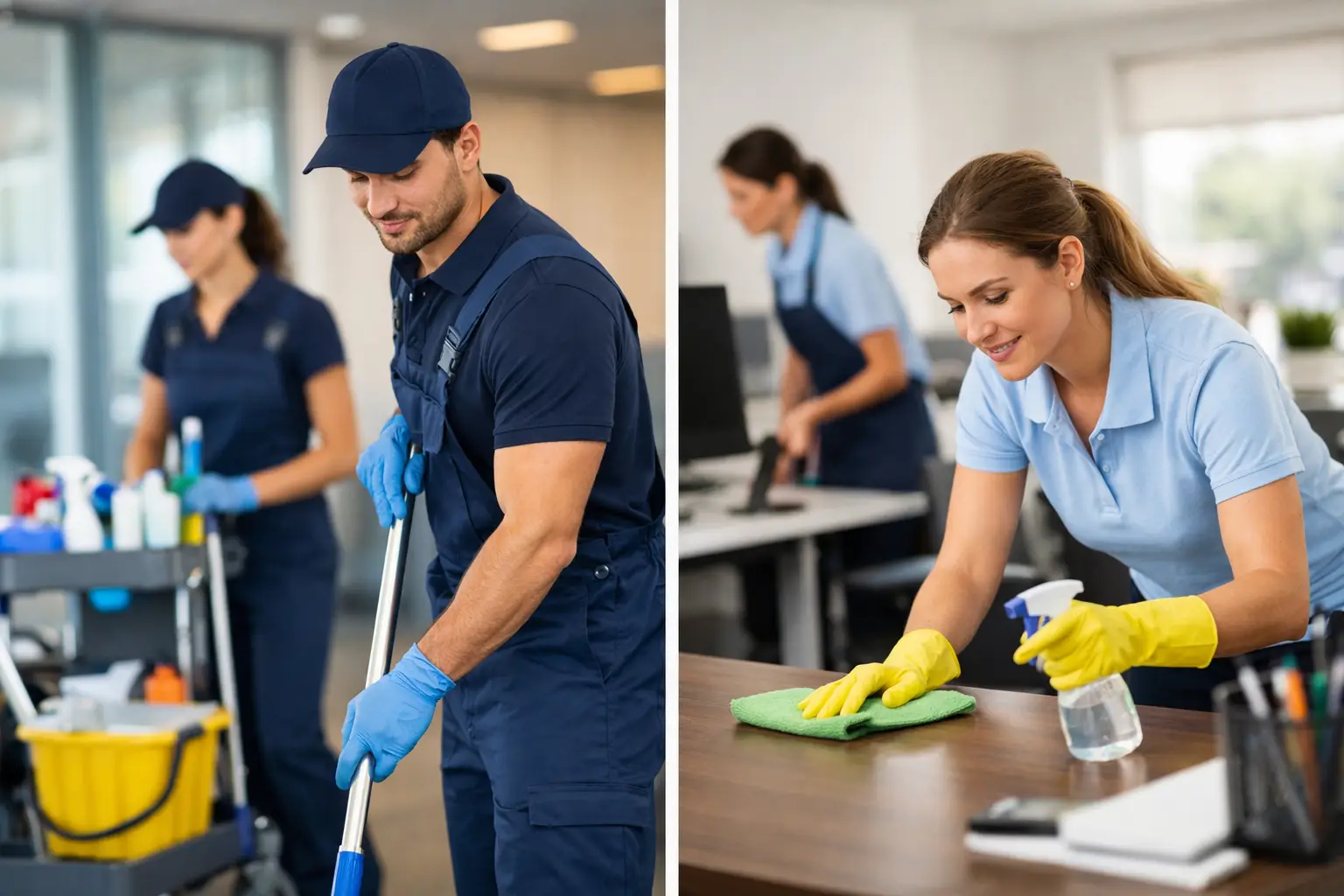
Contractor Versus In-House Cleaners for Offices
A cleaner calling in sick at 5pm can become a facilities issue by 9am the following morning. For office and property managers, the decision between contractor versus in-house cleaners is therefore about much more than who empties bins and cleans washrooms. It affects workplace readiness, management time, health and safety, presentation and the ability to respond when the building’s needs change.
Both models can work well. The right choice depends on the nature of the premises, the range of services required and the internal resource available to manage people, quality and compliance. The most useful comparison is not simply who performs the cleaning, but who carries responsibility for consistent standards every day.
Contractor versus in-house cleaners: the operational difference
An in-house team is employed and managed directly by the organisation occupying or running the building. This can create a close connection between the cleaners, office culture and daily routines. The team may know the premises exceptionally well, recognise regular occupants and respond quickly to familiar requests.
A contracted cleaning provider supplies the operatives, supervision, training structure and service management under an agreed cleaning plan. The provider is accountable for delivering the required outcome, while the facilities or office manager retains visibility and control through communication, inspections and performance reviews.
The distinction matters most when cleaning is treated as an operational service rather than a background task. A commercial site may need daily office cleaning alongside periodic carpet care, hard-floor maintenance, washroom services, window cleaning, deep cleaning or post-build work. It may also contain high-sensitivity areas such as server rooms, meeting suites and IT equipment that need the correct methods and materials. Managing that range internally requires more than scheduling a daily shift.
The case for an in-house cleaning team
For a stable, single-purpose site with consistent hours and straightforward requirements, an in-house team can offer familiarity and direct day-to-day control. Managers can set priorities face to face, adjust individual tasks quickly and build a team that feels embedded in the workplace.
This arrangement can be particularly appealing where cleaning requirements rarely change and an organisation already has established systems for recruitment, induction, people management and health and safety oversight. A trusted in-house operative can become a valued part of the wider building team, with a detailed understanding of the premises and its users.
However, direct employment also places the operational responsibility with the client. That includes arranging absence cover, supervising standards, maintaining training records, managing holiday cover and ensuring cleaning chemicals, equipment and procedures are suitable for the task and follow the H&S legislation. Where a team is small, one unplanned absence can have an immediate effect on service delivery.
The challenge becomes greater where a building requires specialist work. Hard floors, natural stone, high-level areas, IT environments and post-construction spaces all demand appropriate knowledge, machinery and risk controls. Asking a general cleaning team to take on these tasks without the right support can create avoidable risk to surfaces, equipment and people.
What a commercial cleaning contractor changes
A capable contractor transfers much of the employment and service-management burden to a specialist partner. The cleaning plan should still be built around the client’s priorities, building occupancy and working patterns, but the provider takes responsibility for supplying trained operatives, appropriate supervision and reliable cover.
This creates resilience. If a regular operative is unavailable, there should be a clear process for deploying a trained replacement who understands the site specification and expected standards. For facilities teams managing busy offices in Central London, where building access, security procedures and out-of-hours work must all be coordinated, that continuity is valuable.
A contractor also brings a broader service capability. Rather than treating a spill, a stained carpet, a damaged floor finish or a hygiene concern as separate operational problems, managers can draw on a single provider that understands the site. This is especially helpful when a requirement is occasional but time-critical, such as electrostatic disinfection, graffiti removal, deep cleaning before a key event or cleaning following fit-out works.
The value is not simply a larger workforce. It is the systems around that workforce: documented procedures, site induction, method statements where needed, controlled chemical use, quality checks and a clear escalation route. For corporate premises, those details are often what turn a cleaning specification into a dependable service.
Quality control should be visible, not assumed
Whether cleaners are employed in-house or supplied by a cleaning contractor, standards need to be measured. A clean-looking reception is only one indicator. Effective quality control considers washroom hygiene, touchpoints, waste handling, consumable levels, cleaning of overlooked areas and the condition of high-use surfaces over time.
In-house teams need an appointed manager with the time and knowledge to inspect work, address gaps and keep records. Without this, standards can become inconsistent even when individuals are hardworking and committed.
With a cleaning contractor, ask how inspections are completed, how feedback is recorded and how issues are closed out. A good provider will make accountability straightforward, with regular communication rather than waiting for a complaint. The aim is to identify small issues before employees or visitors notice them.
Compliance and safety need specialist ownership
Cleaning carries practical health-and-safety responsibilities. These include safe use and storage of chemicals, COSHH procedures, manual handling, slips and trips, infection control, working at height where applicable, and the protection of occupants during cleaning activity.
An internal team requires the employer to maintain the relevant training, documentation and oversight. This is achievable, but it needs ongoing attention. It is not enough to provide an induction once and assume every task remains low risk.
A specialist contractor should have established compliance systems, regularly trained staff and suitable accreditations to support its approach. ISO 9001, ISO 14001 and ISO 45001 provide useful indicators of formal quality, environmental and occupational health-and-safety management. They do not remove the need for site-specific planning, but they demonstrate that cleaning is being managed within a structured framework.
Flexibility is often the deciding factor
Office use is rarely fixed. Hybrid working can change occupancy patterns from one day to the next. A growing business may take additional floors, while a refurbishment may create dust, waste and short-notice cleaning needs. Seasonal events, executive visits and extended opening hours can all alter the service required.
An in-house team may adapt well where capacity is available. Yet larger changes can place pressure on staffing, equipment and supervisory time. A cleaning contractor is often better positioned to vary shift patterns, increase service during busy periods and introduce specialist support without requiring the client to build those capabilities internally.
Flexibility should not mean uncertainty. The strongest arrangements are based on a clear specification that sets out routine tasks, frequencies, access arrangements, responsibilities and reporting, with a practical process for planned and urgent changes. This gives managers confidence that an altered requirement will be handled properly rather than informally patched over.
Questions to ask before choosing a cleaning model
The decision becomes clearer when it is tied to the building rather than an abstract preference. Consider the following questions:
- Does the premises need only routine office cleaning, or a combination of specialist and periodic services?
- Who will manage recruitment, cover, training, supervision and performance records?
- How will cleaning standards be inspected and issues resolved?
- What happens when the regular team is absent, the office footprint changes or an urgent requirement arises?
- Are there sensitive spaces, such as server rooms or client-facing areas, that need specialist methods and controls?
- Can the chosen model demonstrate environmental, quality and health-and-safety compliance?
These questions reveal where the real workload sits. A cleaning arrangement should reduce pressure on facilities management, not create a second people-management function behind the scenes.
Choosing a partner, not simply additional labour
For many organisations, a specialist contractor is the more practical choice when consistency, compliance and service breadth matter. The right provider should feel like an extension of the facilities operation: responsive to the site, clear about responsibilities and committed to well-supported operatives. EDM Cleaning takes this partnership approach by building tailored plans around each workplace and supporting them with trained teams, quality control and specialist cleaning capability.
That does not make in-house cleaning the wrong answer. A well-led internal team can perform exceptionally in the right environment. The key is to choose the structure that gives the building reliable standards, proper cover and accountable management – then give the people delivering the service the support they need to take pride in it.
A well-maintained workplace quietly reassures everyone who enters it. When cleaning is organised around that outcome, facilities managers are free to focus on the wider running of the building, confident that tomorrow’s workplace will be ready for business.