
Reducing Workplace Floor Slip Risks at Work
A polished reception floor can become a safety concern within minutes of a rainy London morning. Water tracked in from the street, a drink spilled beside a desk or cleaning residue left behind after a rushed task can all change the surface underfoot. Reducing workplace floor slip risks requires more than placing a warning sign by a wet patch. It depends on a planned approach to cleaning, maintenance, reporting and accountability.
For facilities and operations teams, the objective is straightforward: keep every area safe, presentable and ready for employees, visitors and contractors, without disrupting the working day. The details, however, need to reflect how people actually use the building.
Why floor slip risks build up so quickly
Slips are rarely caused by one factor alone. They tend to arise when a changing condition meets an unprepared surface. Entrance areas become wet during poor weather. Pantry floors collect small spills throughout the day. Washrooms require frequent wet cleaning. Hard floors can become less slip resistant when dirt, polish, cleaning chemicals or water are allowed to build up.
High-footfall areas deserve particular attention because the risk is not constant. A corridor may be dry and clear at 9am, then affected by wet umbrellas, catering deliveries or a meeting-room refreshment spill an hour later. This is why a cleaning plan based only on an overnight service can leave avoidable gaps during occupied hours.
The consequences also extend beyond an individual incident. A slip can interrupt operations, require investigation and damage confidence in how a workplace is managed. Preventive floor care is therefore part of business continuity and workplace readiness, not simply a housekeeping task.
Reducing workplace floor slip risks through planned cleaning
A good floor-safety programme starts with an accurate picture of the premises. Different surfaces, traffic patterns and operational uses require different controls. The appropriate method for a stone-floored reception is not necessarily right for vinyl in a washroom, carpet tiles in an office or an anti-slip finish in a back-of-house area.
Match the method to the surface
Hard-floor cleaning needs the correct chemical, dilution and equipment for the material and its finish. Using too much product can leave a residue that attracts further soil or affects traction. Using an unsuitable product may dull a surface, undermine its protective treatment or create an unnecessarily slippery finish.
This is one reason trained operatives matter. They should understand the site instructions, follow COSHH procedures and know when a floor needs routine cleaning, spot treatment, machine scrubbing or specialist maintenance. Regular hard-floor maintenance also helps remove embedded dirt that everyday mopping may not address.
There is a practical balance to strike. Deep cleaning and restorative maintenance can improve both presentation and safety, but the work may require an area to be temporarily closed or scheduled outside peak hours. Planning this work around occupancy, access routes and client activity avoids replacing one operational issue with another.
Clean at the right time, not only at a fixed time
Cleaning frequency should follow risk, not habit. A quiet executive suite may need a different schedule from a busy shared kitchen, customer reception or entrance lobby. During wet weather, entrance checks may need to increase substantially. In a building with frequent client meetings, a mid-day inspection of key routes may be more valuable than an additional low-risk task elsewhere.
Daytime cleaning and janitorial support can provide the responsive element that scheduled out-of-hours cleaning cannot. A visible, trained operative can deal with a spill promptly, replace saturated entrance mats and make sure warning signage is removed once the surface is dry. Leaving signs in place long after the hazard has gone can encourage people to ignore them when they are genuinely needed.
Control water at the entrance
Entrances are often the first pressure point, particularly across the City of London and the West End where commuter footfall can be heavy and weather conditions change quickly. The aim is to stop water and grit travelling beyond the threshold.
Effective matting should be large enough to allow people to take several steps across it, securely positioned and checked frequently. A mat that curls at the edge, becomes saturated or slides on a smooth floor is a risk in its own right. It should be replaced, dried or repositioned before it becomes ineffective.
Reception teams and cleaning operatives should also have a clear wet-weather routine. That may include more frequent inspections, access to dry mop heads, a defined storage point for umbrellas and an agreed escalation route when conditions require more support. The most reliable arrangements are simple enough to be followed on a busy morning.
Make spill response immediate and consistent
A spill does not need to be large to create a slip risk. Small amounts of water, coffee, milk or hand sanitiser can be difficult to see on some hard floors, especially under artificial lighting. Employees should know how to report a spill quickly, while designated staff should know how to isolate, clean and confirm the area is safe to use again.
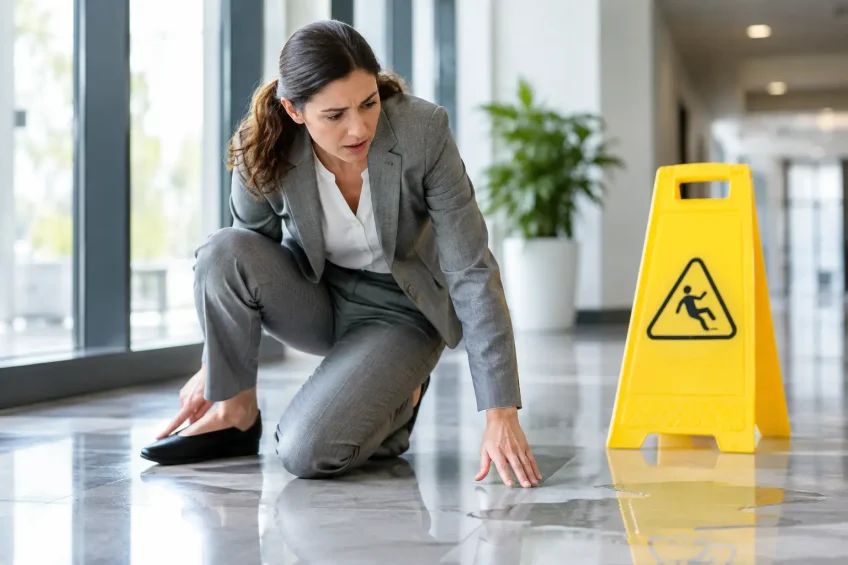
Warning signs are an essential temporary control, not the solution itself. They should be placed before cleaning begins, positioned where people approaching from either direction can see them, and removed as soon as the floor is dry. Where a route cannot be safely restored immediately, a suitable alternative route should be available.
A spill-response process works best when it is documented but not overcomplicated. Record recurring issues, such as a leaking appliance in a kitchenette or water gathering beside an entrance door. Repeated incidents are usually evidence that the underlying condition needs attention, whether that means adjusting cleaning frequency, repairing equipment or changing the layout.
Pay attention to the areas people overlook
Some of the most persistent slip risks sit outside the obvious reception and washroom zones. Tea points can develop a greasy film around bins, coffee machines and dishwashers. Printer areas may collect water from refill stations. Lift lobbies can be affected by umbrellas and wet shoes. Cleaner cupboards, loading areas and plant-room approaches can suffer from leaks, poor drainage or unsuitable storage.
Stairwells also need careful inspection. Dust and debris on treads, worn nosings, poor lighting and objects left on steps all raise the likelihood of a fall. Cleaning should support clear routes, rather than create obstructions through poorly placed equipment, bags or temporary supplies.
The same applies to external approaches under a building’s control. Leaves, rainwater and surface contamination can be carried straight into the workplace. Facilities teams should consider the journey from pavement to desk rather than treating the front door as the only point of responsibility.
Build checks into everyday facilities management
The strongest control is a routine that makes floor condition visible. Regular inspections should focus on entrances, shared kitchens, washrooms, main routes, staircases and any area with a known history of spills or leaks. The findings should lead to action, rather than becoming a formality completed for the record.
Quality-control checks from a commercial cleaning partner can add useful independent oversight. Supervisors can identify declining floor condition, verify that cleaning methods are being followed and adjust the service where building use changes. This is especially valuable after a fit-out, a move to hybrid working or an increase in visitor numbers, when established cleaning patterns may no longer match the site.
Clear reporting is equally useful. Facilities managers need confidence that issues have been logged, remedial action completed and recurring risks raised for review. A dependable cleaning provider should reduce administrative burden by communicating clearly, maintaining standards and taking ownership of the work within the agreed scope.
Train people without making safety everyone else’s problem
Every employee can help by reporting a spill or keeping walkways clear, but responsibility for prevention must remain organised. Staff should not be expected to select chemicals, use specialist equipment or manage hazards without training and support.
Cleaning operatives need site-specific induction, safe systems of work and regular refresher training. They should understand how to use signage, handle chemicals, store equipment safely and recognise when a defect requires escalation. Facilities teams, meanwhile, should make sure cleaning and maintenance staff have access to the information they need, including changes to floor finishes, building layouts and high-risk events.
At EDM Cleaning, trained operatives, formal quality controls and tailored service plans support this practical, accountable approach. The goal is not simply to leave a floor looking clean, but to maintain a workplace that is safe and ready for business.
Treat floor condition as an ongoing standard
Reducing slip risks is not achieved by a single deep clean or a stack of warning cones. It comes from consistent daily standards, responsive support when conditions change and periodic maintenance that protects the floor over time. When cleaning, building management and staff reporting work together, floor safety becomes part of the normal rhythm of a well-run workplace.
The most helpful next step is to walk the building at its busiest and least predictable time, then assess the route as employees and visitors experience it. That view often reveals the practical improvements that a checklist alone will miss.