Scrubbing Versus Burnishing for Commercial Floors
A dull, marked floor can undermine the appearance of an otherwise well-managed workplace. For facilities teams, the choice between scrubbing versus burnishing is not simply about restoring shine. It affects slip resistance, the life of the floor finish, disruption to occupiers and the long-term condition of a valuable asset.
Both methods have a place in a planned hard-floor maintenance programme, but they solve different problems. Selecting the right one begins with understanding what is happening at the surface, what sits beneath it, and how the area is used each day.
Scrubbing versus burnishing: the essential difference
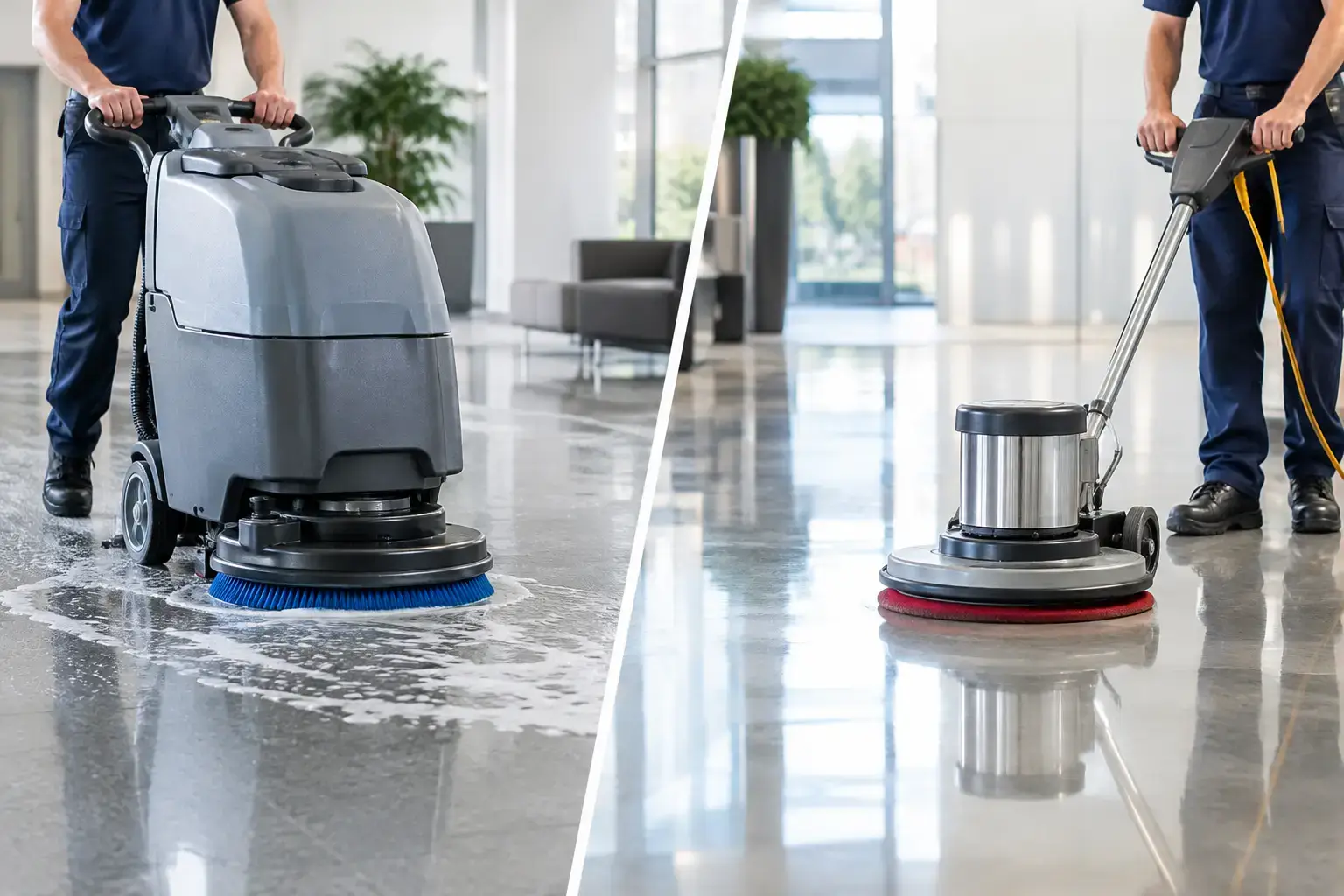
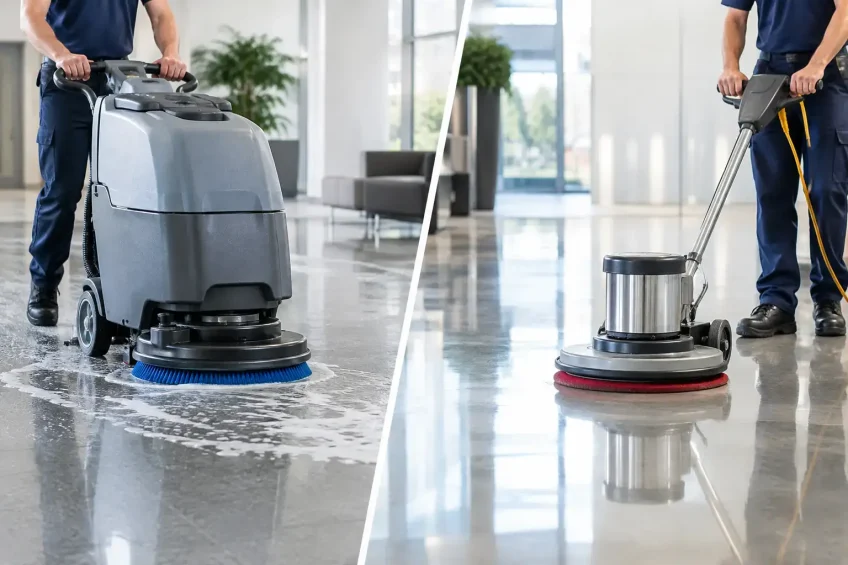
Scrubbing is a cleaning process. A rotary machine, scrubber dryer or suitable mechanical equipment uses water, a controlled cleaning solution and an abrasive pad or brush to remove embedded soil, traffic film and residues from the floor surface. The dirty solution is then recovered, leaving the area clean and ready for drying or further treatment.
Burnishing is a finish-maintenance process. It uses a high-speed or ultra-high-speed machine and a burnishing pad to generate friction across a clean, dry floor with a compatible finish. This action smooths and hardens the upper layer of the finish, helping to restore gloss and improve the floor’s ability to resist future scuffs and marks.
Put simply, scrubbing removes contamination. Burnishing improves the appearance and durability of an existing floor finish. Burnishing a floor that is still dirty may spread soil, create an uneven result and place unnecessary wear on the surface. Equally, repeatedly scrubbing a floor that only needs burnishing can shorten the useful life of the finish.
When commercial floors need scrubbing
Scrubbing is usually required when routine mopping no longer produces a clean, even appearance. Entrances, lift lobbies, corridors, breakout areas and kitchens often collect fine grit, spill residues, footwear marks and airborne dust that become compacted over time. This soil can make a floor appear grey or patchy, even where daily cleaning standards are consistently maintained.
A periodic scrub is also appropriate before applying or repairing floor finish. New layers of finish need a clean, properly prepared surface to bond effectively. If residue remains beneath the coating, the result may be uneven, less durable and more prone to premature marking.
For facilities managers, the key is to distinguish surface dirt from finish failure. A floor may look dull because it needs a thorough scrub. It may also look dull because the protective finish has worn away, in which case restorative work, re-coating or stripping may be necessary. An experienced cleaning team should assess the floor rather than apply the same treatment by default.
The role of pads, brushes and cleaning chemistry
The combination of machine, pad or brush, cleaning solution and dwell time must suit the floor material and the level of soiling. A pad that is too aggressive can damage a finish or alter the appearance of a sensitive surface. Too little agitation, on the other hand, may leave traffic film behind and make the work ineffective.
This is particularly relevant in multi-tenant buildings, where flooring types may change between reception, washrooms, kitchens, meeting rooms and back-of-house areas. Vinyl, linoleum, safety flooring, sealed concrete and ceramic tiles all require different maintenance decisions. Natural stone demands still greater care, as unsuitable products or excessive mechanical action can cause lasting damage.
When burnishing is the right response
Burnishing is most effective on resilient flooring with a sound, compatible finish that has become lightly scuffed or has lost its gloss through normal foot traffic. It is common in office receptions, main circulation routes and other highly visible spaces where presentation matters to employees, clients and visitors.
A well-timed burnish can restore a polished appearance without the disruption of more intensive restoration. It also helps maintain a smooth finish, making daily dust control and damp mopping more effective. The benefit is operational as well as visual: a floor that is easier to maintain supports consistent standards between periodic services.
However, a high-gloss result is not the right objective for every area. In entrances exposed to rain, in food preparation areas, or on designated safety flooring, slip resistance and material specification must take priority. The correct floor-care plan balances presentation with safe use, rather than pursuing shine for its own sake.
Frequency depends on traffic, not a fixed calendar
There is no universal schedule for burnishing. A corporate reception with constant visitor traffic may benefit from frequent attention, while a lightly used meeting suite may need only occasional maintenance. Weather, building location, entrance matting, cleaning frequency and the number of occupants all influence how quickly a floor shows wear.
The same principle applies to scrubbing. A London office close to a busy street may carry more grit into the building than a site with a protected entrance and effective matting. Monitoring floor condition, rather than relying solely on a calendar, allows facilities teams to direct resources where they will have the greatest impact.
The risks of choosing the wrong treatment
The most common mistake is to use burnishing to compensate for inadequate cleaning. A burnisher cannot remove ingrained dirt, sticky residues or heavy traffic film. Used in those circumstances, it can leave a floor looking inconsistent and may cause marks to become more noticeable under overhead lighting.
Over-scrubbing presents a different risk. Each mechanical clean has an effect on the protective finish. If aggressive pads, unsuitable chemicals or excessive pressure are used repeatedly, the finish can wear prematurely. The floor may then become harder to clean, more vulnerable to staining and more expensive in time and materials to restore.
Another concern is downtime. Scrubbing uses water and requires suitable drying time, warning signage and controlled access. Burnishing is generally a drier process, but it can generate noise and requires clear working space. In occupied commercial premises, the service should be planned around building activity, with risk assessments, safe systems of work and communication to relevant site contacts.
Building a practical hard-floor maintenance plan
A reliable programme starts with a site survey. The cleaning provider should identify floor types, existing finishes, areas of high traffic, visible damage, cleaning access and the hours when work can be carried out with minimal disruption. This creates a clear baseline for deciding which areas need daily cleaning, periodic scrubbing, scheduled burnishing or more substantial restoration.
Daily care remains the foundation. Entrance matting should be maintained, dry debris removed before it is walked into the surface, and spills dealt with promptly. These simple controls reduce abrasive wear and stop soils becoming embedded in the finish.
Periodic work can then be planned according to actual use. Scrubbing may be scheduled ahead of a re-coat, after winter weather, or when inspection shows traffic film building up. Burnishing can be programmed for prominent finished floors once they are clean and dry, helping them retain an even appearance between deeper maintenance visits.
Quality control matters throughout. Operatives need training in equipment selection, pad identification, chemical dilution, COSHH procedures and the limits of each flooring material. Supervisory checks should confirm that the finish is even, edges have been addressed, residues have been removed and the area is safe to reopen. For a facilities manager, this documented approach provides assurance that floor care is being managed as part of the building’s wider operational standards.
Protecting appearance without compromising performance
A clean, well-maintained floor supports the workplace experience from the moment someone enters the building. It also protects the underlying material, reduces the likelihood of avoidable wear and helps cleaning teams work more efficiently over time.
EDM Cleaning approaches hard-floor maintenance as a tailored programme rather than a one-size-fits-all task. The right balance of daily cleaning, scrubbing, burnishing and specialist restoration should reflect the floor, the traffic it carries and the standards the premises need to maintain.
Before the next visible decline becomes a larger restoration project, arrange a practical review of the floors that carry the greatest daily demand. A clear maintenance plan gives your team confidence that each surface will receive the treatment it actually needs.