Server Room Cleaning Service for London Offices
A server room cleaning service is a controlled facilities task, not an extension of routine office cleaning. Dust, loose fibres and accidental disruption can affect cooling, access and equipment performance, so the work must be planned around the room, its hardware and the organisation’s operating requirements.
For facilities managers, the objective is straightforward: maintain a clean, orderly environment without introducing avoidable risk to critical IT infrastructure. That calls for trained operatives, appropriate methods, clear site communication and quality controls that give the business confidence in every visit.
Why server room cleanliness matters
A server room is designed to support systems that may be working continuously. Airflow, cooling units, cable routes, raised floors and equipment racks all need to function without unnecessary obstruction. Over time, dust can settle on surfaces, gather around vents and become trapped in areas that are difficult to reach during day-to-day housekeeping.
This does not mean every particle of dust presents an immediate failure risk. The practical concern is accumulation. When contamination builds up, it can contribute to restricted airflow, place additional demand on cooling systems and make it harder for IT teams to inspect the room properly. A clean environment also supports a more professional maintenance regime, where labels, cabling and access routes remain visible and manageable.
The risks are not limited to dust. Cleaning activity that is poorly controlled can create its own problems. Ordinary vacuums may not be suitable for sensitive environments, wet processes can be inappropriate near electrical equipment, and unbriefed operatives may inadvertently move cables, block access or interfere with room controls. The right approach is therefore as much about protecting continuity as it is about appearance.
What a professional server room cleaning service should include
A specialist visit should begin with an understanding of the space. Before work starts, the cleaning provider should agree the permitted scope with the facilities and IT contacts, identify restricted equipment or zones, confirm access arrangements and establish whether cleaning must take place outside core working hours.
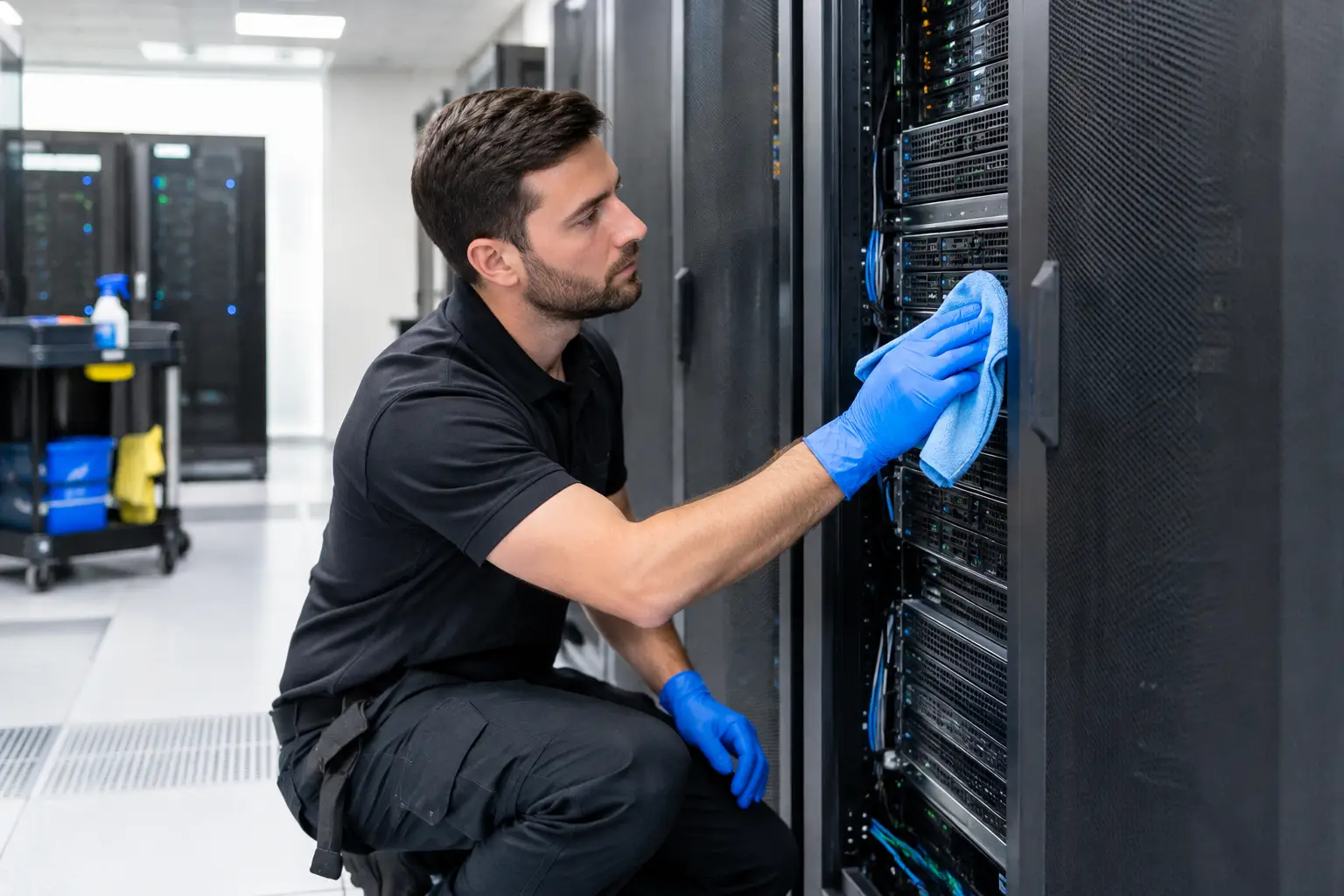
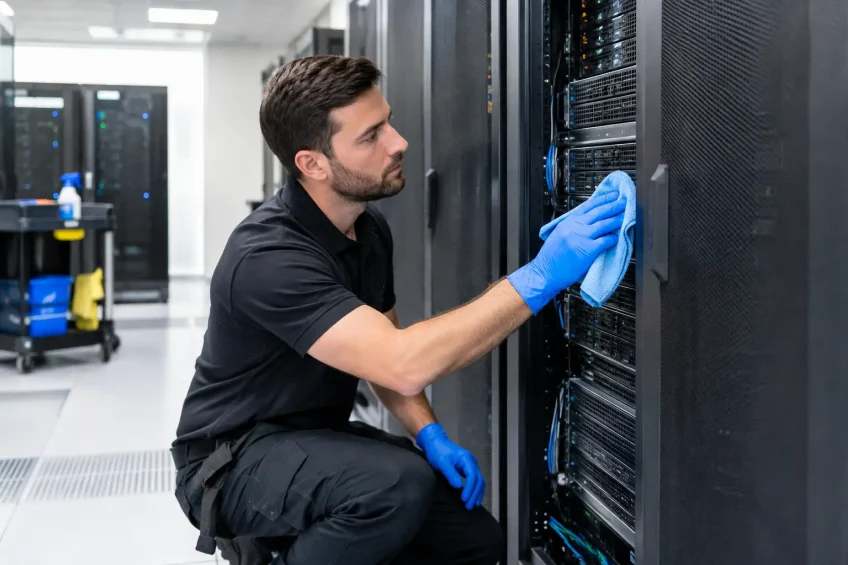
The work itself is typically focused on the room’s accessible environment: floors, skirting, ledges, external rack surfaces, door areas and other agreed surfaces. Methods should be selected to minimise the disturbance of settled dust. Equipment must be clean, maintained and appropriate for the task, while products should be used only where they are safe and approved for the area.
A reliable service also leaves an audit trail. Depending on the site, this may include a task specification, attendance records, supervisor checks and reporting of any visible issues such as blocked vents, damaged floor tiles, unsecured cable management or signs of water ingress. Cleaning teams should report these observations, not attempt technical repairs outside their remit.
Cleaning around live equipment
Most server rooms cannot simply be taken out of operation for cleaning. That makes coordination essential. The cleaning plan should respect active equipment, preserve required clearances and avoid contact with ports, cables, control panels and internal components.
There is no single schedule that suits every site. A small, well-sealed communications room with limited footfall may need periodic specialist attention, while a larger server environment near a busy office, loading area or construction project may require more frequent inspections and cleaning. The right frequency depends on the room’s location, ventilation, usage, existing housekeeping standards and business-criticality.
Where there has been building work, a leak, a ventilation fault or an unusual dust event, an additional targeted clean may be sensible. In these situations, facilities and IT teams should agree the scope together before the work is booked.
Planning the work around operational continuity
The strongest cleaning plans are built around the site rather than applied as a generic checklist. Facilities managers should expect their provider to ask practical questions: Who authorises access? Is an escort required? Are there areas that must not be touched? What are the escalation contacts if an issue is identified? Are there change-control procedures for work in the room?
For many London offices, scheduling is equally important. Early-morning, evening or weekend attendance can reduce disruption, but timing alone is not enough. Operatives need clear instructions before arriving, including the entry route, sign-in process, security requirements and any site-specific health and safety controls.
A well-managed provider will also make responsibilities clear. The cleaning team is responsible for delivering the agreed specification safely and consistently. The client’s IT representative retains responsibility for equipment and technical decisions. This division protects both parties and helps prevent a routine cleaning visit from becoming an unplanned operational event.
The standards behind dependable delivery
Specialist cleaning relies on people as much as equipment. Operatives working in sensitive areas need training in safe systems of work, COSHH awareness, security expectations and escalation procedures. They should understand that a server room is not a storage area, shortcut or place to leave cleaning materials unattended.
Formal management systems provide further reassurance. ISO 9001 supports a disciplined approach to service quality and corrective action, ISO 14001 informs environmental management, and ISO 45001 strengthens occupational health and safety processes. These frameworks do not replace careful on-site planning, but they provide a useful structure for consistent delivery, review and improvement.
Quality control should be visible rather than assumed. Regular supervisory inspections, clear communication with the contract manager and a process for responding to feedback help ensure that standards are maintained over time. This is particularly valuable where server room cleaning forms part of a wider office-cleaning contract. One accountable provider can coordinate the work while preserving the specialist controls the space requires.
Questions to settle before arranging a clean
Before appointing a provider, facilities teams should confirm the scope in writing. It is worth agreeing which surfaces will be cleaned, whether raised-floor areas are included, what equipment and products will be used, and what work is explicitly excluded. If an IT shutdown or rack access is required for any element of the job, that must be led by the appropriate technical team.
Security should also be part of the conversation. Server rooms often contain sensitive infrastructure, so access must be limited to authorised personnel and managed in line with the building’s procedures. Visitor records, identification requirements and escorted access can all be relevant depending on the site.
Finally, consider the reporting route. If operatives find unusual debris, moisture, damaged fittings or an obstruction near cooling equipment, who should receive the notification and how quickly? Establishing this before the visit makes the service more useful to the facilities operation.
A practical investment in workplace readiness
EDM Cleaning approaches specialist environments with the same principle that guides every commercial cleaning contract: the service should make the client’s role easier while supporting a safe, ready-to-work premises. For server rooms, that means tailored specifications, trained operatives, appropriate equipment and dependable quality assurance rather than a one-size-fits-all clean.
A clean server room will not replace preventative IT maintenance, environmental monitoring or a business continuity plan. It does, however, support all three by helping to keep the physical environment orderly, accessible and easier to manage. When cleaning is planned with care, it becomes a small but meaningful part of protecting the systems that keep the wider workplace running.