How to Reduce Cleaning Disruption in Offices
A cleaner arriving at the wrong time can turn a necessary service into an operational frustration. Vacuum noise interrupts calls, washroom closures create queues, and a deep-cleaning task beside a client meeting can undermine the very professional image it is meant to protect. Knowing how to reduce cleaning disruption starts with treating cleaning as part of the building’s operating plan, not a task added around the edges of the working day.
For facilities and operations leaders, the aim is not simply to keep disruption low. It is to maintain consistent hygiene, presentation and safety while allowing employees, visitors and contractors to use the workplace with confidence. That requires a cleaning partner that understands how the site functions hour by hour.
Build the cleaning plan around how your workplace operates
A standard cleaning timetable rarely reflects the reality of a busy commercial premises. Offices have peak arrival periods, meeting-room turnover, lunch rushes, deliveries, client visits and quiet periods that vary by floor, department and day of the week. A tailored plan should identify these patterns before operatives begin work.
Start by mapping the spaces where cleaning activity is most visible or most likely to affect people. Reception areas, washrooms, kitchens, shared workspaces, lifts and high-traffic corridors usually need regular attention, but they do not all need it at the same moment. For example, a kitchen may benefit from a touchpoint clean immediately after the lunch peak, while a reception area may need discreet presentation checks before visitor appointments.
This assessment should also distinguish between routine work and periodic specialist tasks. Daily office cleaning can often take place outside core working hours, whereas carpet care, hard-floor maintenance, window cleaning or deep cleaning may need a carefully managed daytime or weekend programme. Separating these activities allows the site to stay clean without creating avoidable interruption.
Agree the non-negotiable times
Every workplace has periods when disruption is unacceptable. These may include board meetings, trading hours, clinical appointments, training sessions, events or times when teams are handling confidential work. Record these restrictions clearly in the site instructions rather than relying on informal conversations.
The same applies to access arrangements. If certain meeting rooms, executive areas, server rooms or secure floors can only be cleaned with an authorised escort, build that process into the schedule. A missed clean caused by unclear access procedures is often more disruptive than the cleaning itself, because it leads to last-minute requests and unnecessary follow-up.
Use the right cleaning frequency, not the highest frequency
More cleaning is not always better for workplace continuity. Over-servicing low-use spaces can create needless movement around the building, while under-servicing busy areas allows issues to build up until urgent intervention is needed. The most effective schedules are based on footfall, risk and the purpose of each space.
A client-facing reception may require several discreet checks throughout the day. A lightly used meeting room may only need attention after bookings, while a washroom needs planned servicing that responds to occupancy and supplies. This approach focuses cleaning resources where they have the greatest operational value.
It also creates room for flexibility. If a large team is working remotely, the schedule can be adjusted to reflect reduced use. If an event, post-build handover or seasonal increase in visitors is expected, additional cleaning can be planned in advance rather than arranged under pressure. A good contract should support these changes without making the facilities team carry the administrative burden.
Select methods and equipment that suit occupied buildings
The equipment used matters as much as the time of day. A method that is appropriate in an empty office may be unsuitable when people are working nearby. Noise, drying times, odours, cables and restricted access all need consideration.
Low-noise vacuum equipment can help where daytime cleaning is necessary, particularly around reception areas and open-plan workspaces. For hard floors and carpets, the chosen process should take account of drying time so that walkways can reopen safely and without creating slip risks. Clear wet-floor signage and sensible sequencing are basic controls, but they are particularly important in buildings with high visitor traffic.
Chemical selection should be equally considered. Products must be used in line with COSHH requirements, with safety information and dilution procedures understood by operatives. Where possible, environmentally conscious cleaning methods can reduce unnecessary chemical use without compromising standards. However, environmental considerations should never result in a product or process that is unsuitable for the surface, hygiene requirement or site risk assessment.
Plan specialist work as a managed project
Deep cleans, carpet extraction, stone cleaning, graffiti removal and post-build cleaning can have a greater impact on normal operations. These services should be planned with a scope of work, agreed access times, protection for adjacent areas and a clear handover process.
For instance, hard-floor restoration may require an area to remain out of use while treatments cure. Carpet cleaning may involve moving furniture or managing drying periods. In these cases, completing the task quickly is only one measure of success. The work must also be coordinated so that staff can return to a safe, presentable and fully usable environment at the agreed time.
Give cleaning teams clear information and authority
Disruption often happens when operatives are left to make decisions without enough knowledge of the site. A trained, well-supported team should know where sensitive work takes place, which routes are busiest, how to report defects and who to contact if access is unavailable.
A concise site file can make a substantial difference. It should cover cleaning specifications, room priorities, security procedures, emergency arrangements, waste processes, equipment storage, site hazards and escalation contacts. It should also identify areas containing confidential information or specialist equipment. Computer, IT-equipment and server-room cleaning require appropriate methods, careful handling and, in many cases, additional access controls.
Operatives should feel able to raise an issue before it becomes a disruption. A blocked washroom, leaking dispenser, damaged floor finish or repeated access problem needs prompt reporting and ownership. This is where a partnership approach is valuable: the cleaning team does not merely complete a checklist, but helps protect the readiness of the premises.
Communicate changes before they affect occupants
Even well-planned cleaning can be disruptive if building users are surprised by it. Communication does not need to be excessive, but it should be timely and practical. Let affected teams know when a work area will be temporarily unavailable, when specialist machinery will be used or when a different route may be required.
Facilities managers should also ensure that cleaning supervisors receive advance notice of exceptional activity. Office moves, visitor events, refurbishment work, staff gatherings and changes to hybrid-working patterns all affect cleaning requirements. A short weekly review can prevent a large number of last-minute requests.
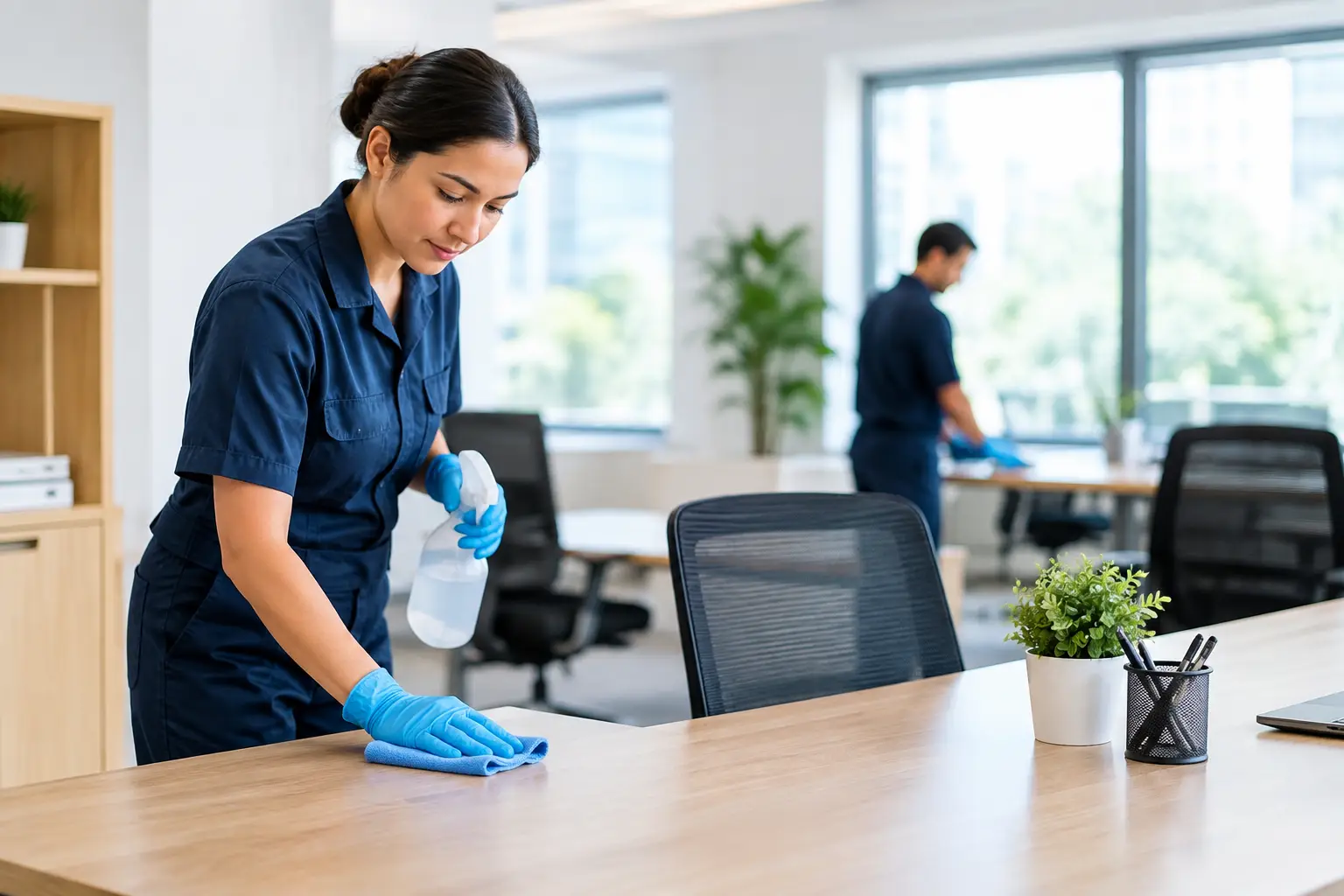
For daytime tasks, visibility should be managed carefully. Smart uniforms, professional behaviour and tidy equipment presentation reassure occupants that work is controlled. Yet the team should not obstruct entrances, fire routes or meeting spaces. The most effective cleaning is often noticed only through the condition of the workplace, not through the interruption it creates.
Measure quality and disruption together
A site can appear clean while still creating too much operational friction. Quality control should therefore look beyond visual results. Regular inspections can assess whether tasks are being completed to specification, but feedback should also capture timing, access issues, noise concerns, consumable availability and response to ad hoc requests.
When reviewing performance, ask practical questions. Are washrooms being serviced before supplies run low? Are meeting rooms ready at the times teams expect to use them? Are daytime operatives working around activity appropriately? Are recurring issues being resolved at source rather than repeatedly reported?
Documented quality systems provide a useful framework for this process. ISO 9001 supports consistent service management, while ISO 14001 and ISO 45001 help reinforce environmental and health-and-safety responsibilities. For clients, the benefit is greater accountability: standards can be checked, trends identified and improvements agreed with evidence rather than assumption.
Keep contingency arrangements ready
No schedule can account for every incident. Spills, illness outbreaks, water ingress, post-event waste and urgent visitor requirements can arise without warning. The difference between a small interruption and a wider operational problem is often the speed and clarity of the response.
A contingency plan should define who can authorise additional work, how emergency requests are reported and what response is expected. It should also consider practical matters such as spare consumables, access to equipment and the availability of trained cover staff. In larger London offices, where building access and loading arrangements can be tightly controlled, these details are especially relevant.
The goal is not to build an overly complicated process. It is to ensure that, when an unexpected need arises, the facilities team knows exactly who owns it and what will happen next.
A well-run cleaning service should support the rhythm of the workplace rather than compete with it. When schedules reflect real occupancy, teams are properly briefed, specialist work is planned carefully and performance is reviewed openly, cleaning becomes a quiet but dependable part of business continuity. That leaves managers free to focus on the workplace experience their people and visitors actually notice.